跳转到主导航 跳转到内容 跳转到注脚
回到博客

When Will the Sagrada Familia Be Finished? The ‘Cherry on Top’ Arrives in 2026

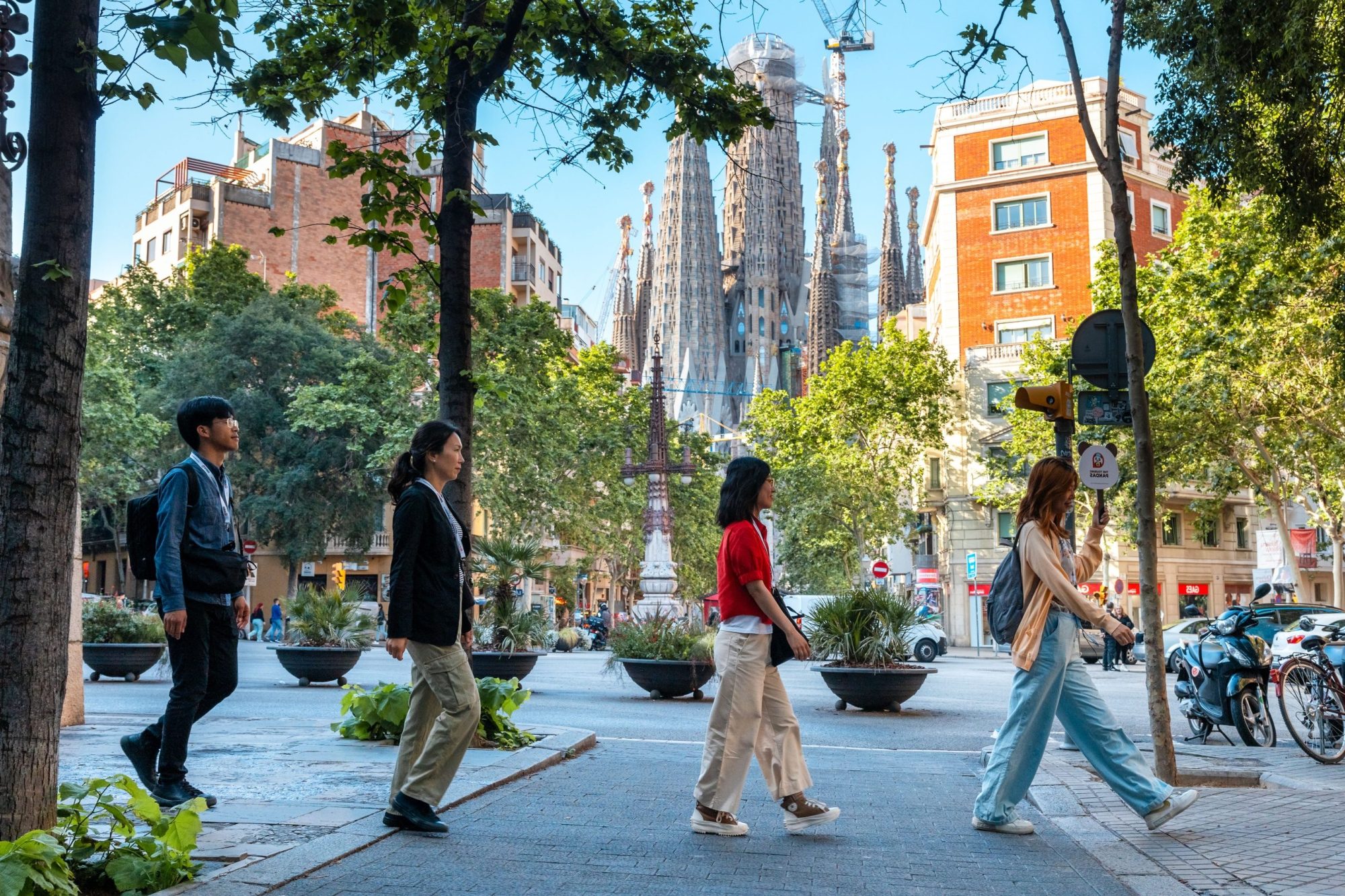
a group of people on a sidewalk during the sagrada familia tour

If you have ever visited Barcelona, or if you dream of doing so soon, there is one silhouette that dominates the horizon and captures the sighs of every traveler: the Sagrada Familia. This is no ordinary church; nothing truly prepares you for its majesty. Standing before it can be, quite simply, overwhelming. It is more than a building; it is the beating heart of the city, a promise of eternal beauty that seems to be in constant evolution.

For decades, the million-dollar question has been: “When will it be finished?” The answer used to seem distant, almost utopian. But today, dear travelers and explorers, we have exciting news. We are no longer talking about an indefinite dream. We are talking about dates, milestones, and a historic moment that we will get to experience very, very soon.

The final stretch has begun. And The Touring Pandas will tell you what’s coming that will forever change Barcelona’s skyline and the experience of visiting it. 🏗️✨


A Little History:The Vision of a Genius

To understand where we are going, we must first look back. The Sagrada Familia was not born as the giant we know today. When the first stone was laid in 1882, the project was a standard Neo-Gothic church under the direction of Francisco de Paula del Villar. But fortunately, fate had other plans. A year later, a 31-year-old architect named Antoni Gaudí took the helm, and with him, the history of architecture changed forever.

The Vision of a Genius Taken for a Madman
1878

When Gaudí graduated from the Barcelona School of Architecture in 1878, the director signed his degree and uttered a phrase that went down in history:

“I do not know if we have awarded this degree to a madman or to a genius; only time will tell.”

By now, there is absolutely no doubt about his genius.

Gaudí didn’t just want to build a church; he wanted to create a physical and spiritual link between heaven and earth. To his contemporaries, his ideas were sometimes incomprehensible and wild. How could those towers stand without flying buttresses? Why those shapes that seemed to melt or grow like plants?

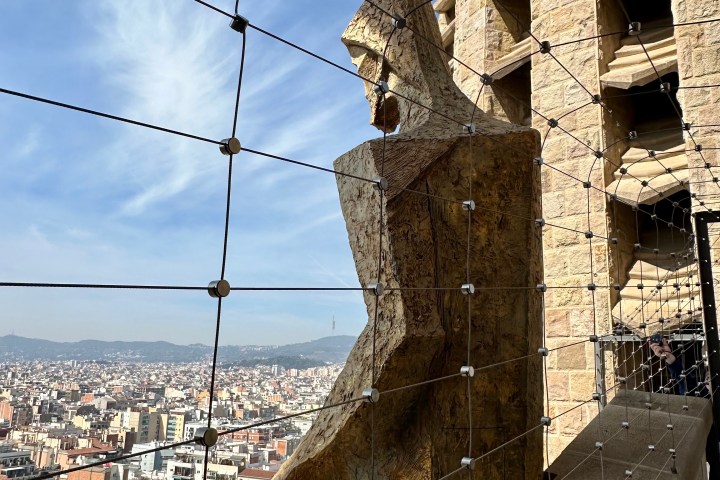
Partial view of Barcelona from a Sagrada Familia tower with the statue of Jesus Christ looking over the city skyline.

Internal view of the stone spiral staircase in the towers of the Sagrada Familia, showcasing Gaudí’s geometric and naturalistic design.

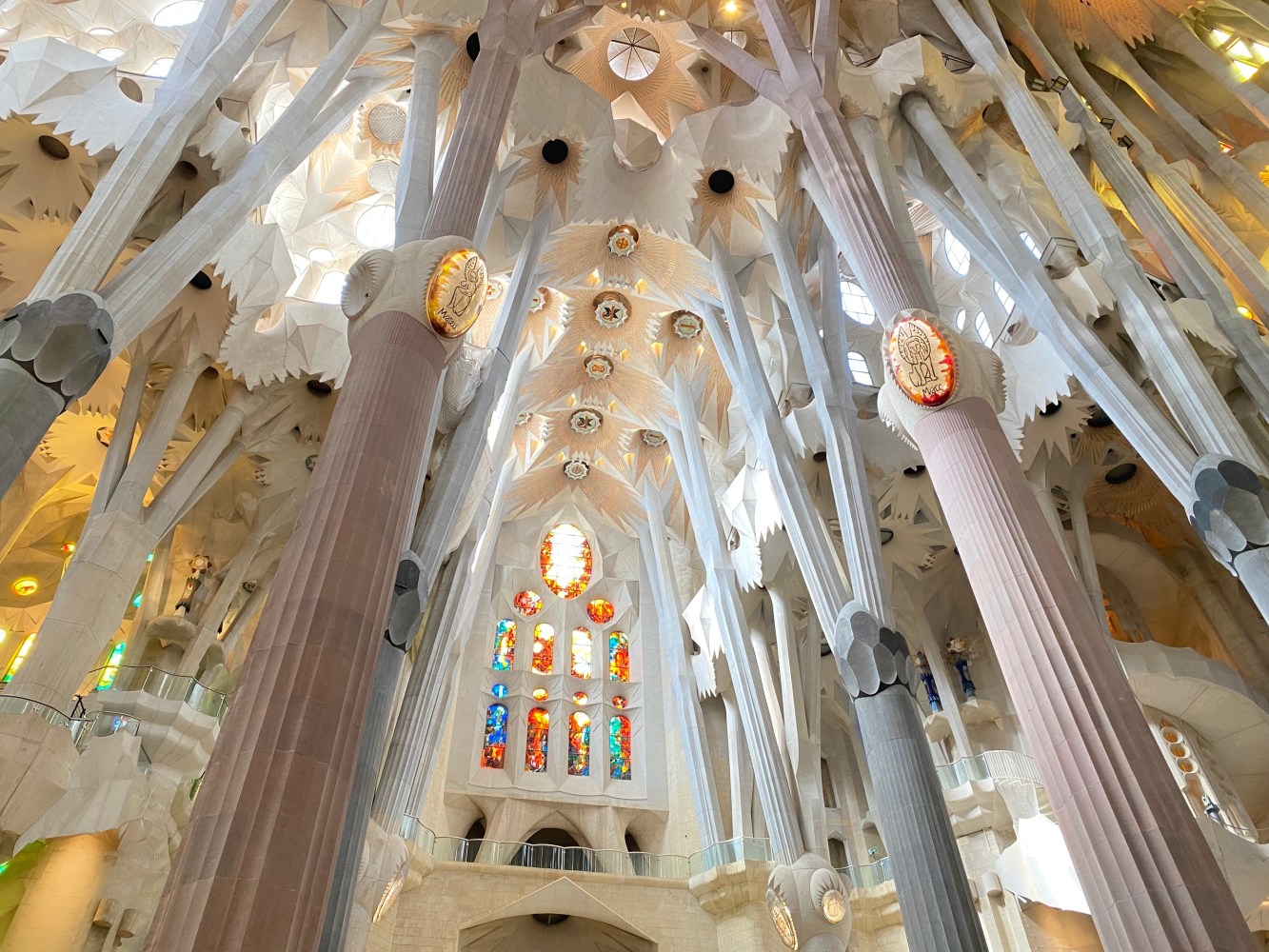
Image of the interior of the Sagrada Familia in Barcelona

Colorful mosaic pinnacle of the Sagrada Familia featuring sacred bread and purple grapes.


Gaudí knew he would not see his work finished. In fact, he used to joke, saying: My client (referring to God) is in no hurry. He dedicated 43 years of his life to this project—the last 12 exclusively—even living inside the temple’s workshop until his tragic death in 1926.

A Bible Sculpted in Stone 📖

The meaning behind the Sagrada Familia is breathtakingly beautiful. Gaudí conceived the temple as a Bible sculpted in stone. His goal was for anyone, whether they could read or not, to understand the history of the Christian faith simply by looking at its walls. Each facade tells a different chapter of the life of Jesus, and it does so with a unique emotional weight:

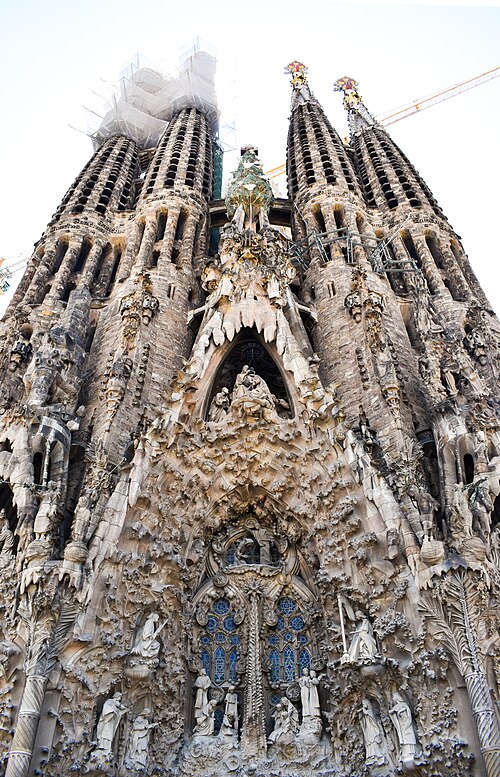
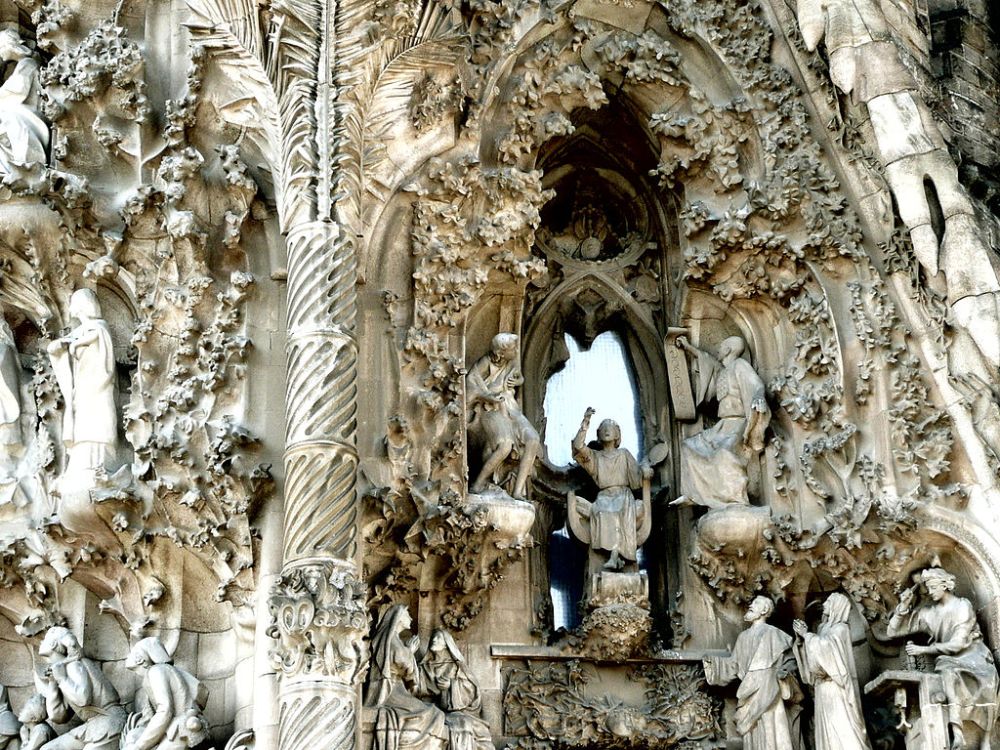
  • The Nativity Facade: This is the only one Gaudí saw almost completed. It is pure joy, nature, and life. If you look closely, you will see turtles, chameleons, and an explosion of flora and fauna celebrating the arrival of Jesus into the world.
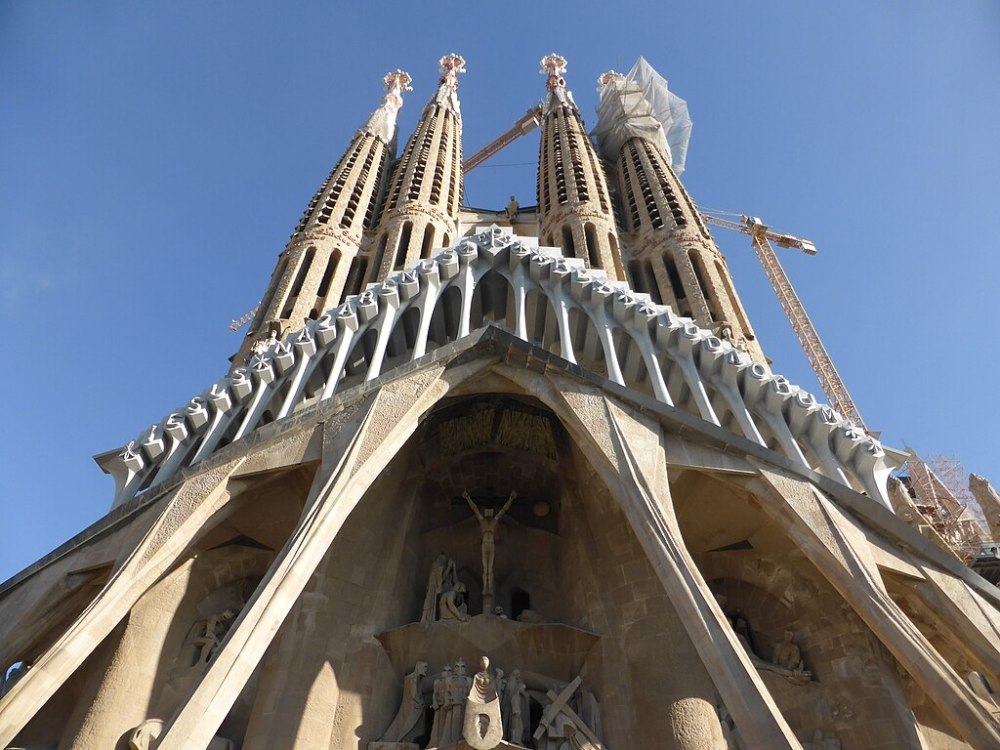
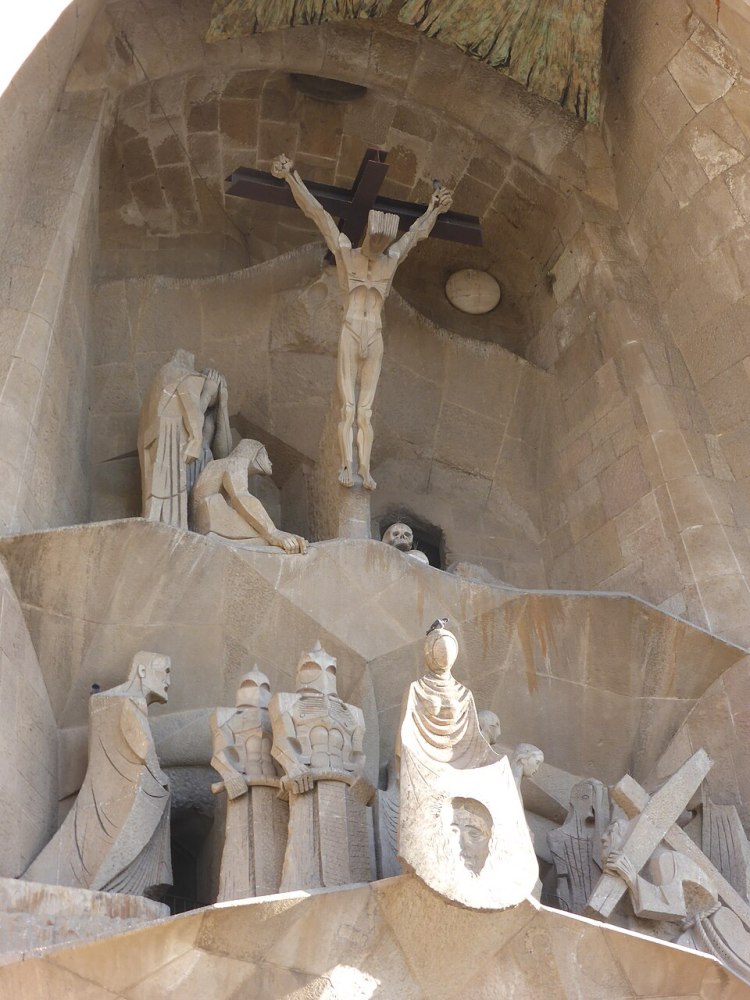
  • The Passion Facade: This is the exact opposite. Austere, geometric, almost skeletal. Its columns look like bones, and the sculptures by Josep Maria Subirachs convey the pain and sacrifice of Christ’s death.
  • The Glory Facade: The one yet to come, destined to explain the destiny of humanity. This facade will be the main entrance to the basilica once finished and will be the most majestic and imposing of all.

Sagrada Familia Nativity Facade

Detailed stone carvings

The Passion Facade

Stone sculpture

What Makes the Sagrada Familia Unique in the World?

There is nothing like it on the planet. The Sagrada Familia is the perfect synthesis of faith, nature, and geometry. Gaudí realized that pure straight lines do not exist in nature, so his temple doesn’t have them either. Everything consists of curves, catenaries, and hyperboloid shapes that allow light to enter and towers to soar toward infinity without the need for bulky external supports. It is, literally, a stone forest where columns branch out like trees to support the ceiling. 🌳

A Forest of Light and Color 🌈

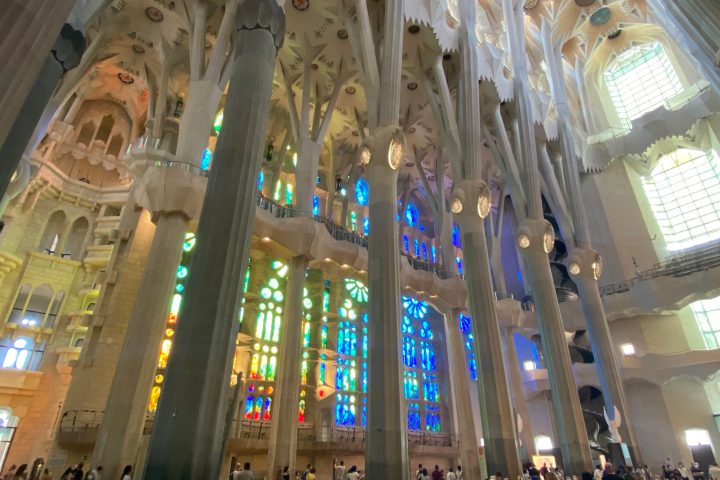
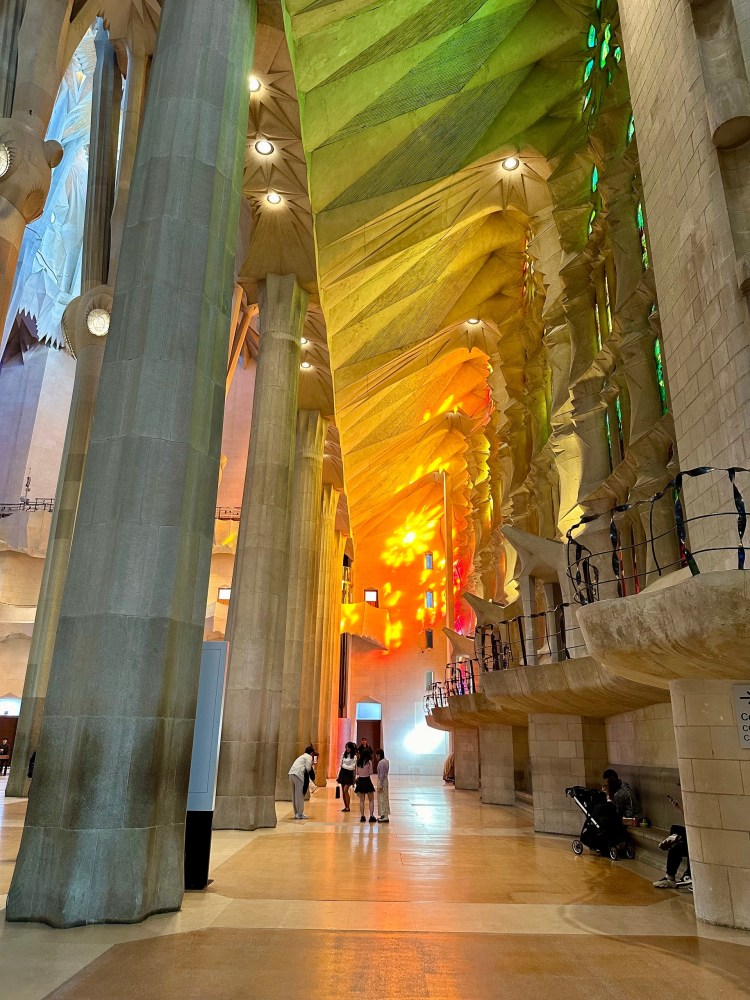
If the exterior of the Sagrada Familia impresses you with its detail, the interior will take your breath away with its atmosphere. Gaudí, a master of light, designed the stained-glass windows to create a chromatic spectacle that changes depending on the time of day. It is not static lighting; it is a living organism.

Interior of a cathedral with tall columns and colorful stained glass windows.

Golden hour at the Sagrada Familia: warm sunset light filtering through stained-glass windows, painting the stone interior in orange and red tones.

  • Cool Tones (Blues and Greens): You will find these in the windows facing east, where the sun rises. They represent birth, the morning, and the freshness of the beginning of life.
  • Warm Tones (Reds and Oranges): These are located in the west, catching the sunset light. These colors symbolize passion, maturity, and fulfillment.

Upon entering, you won’t see traditional lamps; instead, you’ll feel like you’re walking under light filtered through the leaves of a forest. Depending on whether you visit on a bright morning or during a golden afternoon, the basilica will feel like a completely different temple to you. It is, without a doubt, the world’s largest watercolor painted with natural light.

What it Represents for Humanity

Beyond Catholicism, this temple is a UNESCO World Heritage site that unites people of all beliefs. It represents the human capacity to persevere. It is a symbol of patience and collective effort—a work that has survived wars, economic crises, and pandemics, staying true to the dream of a single man who changed art and left an unparalleled legacy for humanity.


What’s Left to Finish? The Final Stretch Has Begun!

This is where the excitement skyrockets. We are about to witness a historic moment this 2026 with the completion of the main structure and its peak, the Tower of Jesus.

The Tower of Jesus: The 2026 Milestone 📅

This is no ordinary year; it commemorates the centenary of Antoni Gaudí’s death in June. To honor his memory, the primary goal is to finish the Tower of Jesus Christ by March. This will not be just another tower. It will be the central and tallest tower of all, reaching 172.5 meters in height. Do you know what this means?

  1. The Sagrada Familia will officially become the tallest building in Barcelona.
  2. It will be the tallest Catholic church in the world, surpassing Ulm Minster in Germany.

The tower will be crowned by a spectacular four-armed cross (typical of Gaudí) covered in glazed ceramic and glass, designed to shine with the sun by day and project its own light at night. It will be a spiritual beacon visible from any point, as its unique shape allows it to be observed as a symbol of faith from all over the city.

Furthermore, for the commemoration in June 2026, a Papal visit is expected to inaugurate this stage, marking the beginning of the final stretch of the masterpiece. And here is some excellent news: the Tower of Jesus will be open to visitors. It will feature an elevator and stairs allowing you to ascend to the heart of the cross, offering views of Barcelona never seen before.

The Glory Facade: The Final Great Challenge (2027-2035)

Once the main tower touches the sky in 2026, efforts will focus on the main entrance: the Glory Facade. Construction is expected to enter its most intense phase starting in 2027, with an estimated completion date around 2035. This facade will explain the origin and end of human beings, the Final Judgment, and Eternal Glory. Architecturally, it will be the most monumental of all.

Gaudí’s original plan includes a grand staircase that would cross Mallorca Street, creating a majestic entrance that would provide direct access to the temple from a large plaza. This would allow for complete visibility of the basilica from a distance—something that is difficult to appreciate today due to the surrounding buildings.


Why is the Construction Taking So Long?

It’s the question we all ask when we see the cranes. “Why isn’t it ready yet? The answer is a mix of romanticism, history, and technical challenges.

  1. Expiatory Funding 💰

The Sagrada Familia is an Expiatory Temple. This means it receives no money from the government or the official Church. It is 100% self-funded through private donations and, above all, the sale of tickets to visitors like you. Every visitor is collaborating with the construction just by visiting. This makes the pace of construction entirely dependent on the flow of tourism.


  1. Historical Challenges and Obstacles

The road has not been easy:

  • The Spanish Civil War (1936): This was the hardest blow. Gaudí’s studio was raided and burned. Original plans and drawings were lost. Model makers had to reconstruct the shattered plaster models to understand how Gaudí wanted the work to continue.
  • Technical Complexity: Integrating the styles Gaudí developed throughout his life and deciphering his geometry has required technology that didn’t exist in the 20th century. Today, drones, 3D printers, and specialized engineering software are used to cut stones with millimeter precision.
  • The Pandemia: When tourism stopped in 2020, construction also had to stop due to a lack of income, delaying the original plans.


  1. The Urban Challenge and the Grand Staircase

This is the final challenge. To build the grand staircase of the Glory Facade as Gaudí dreamed it, it would be necessary to intervene in the current urban layout of Mallorca Street. This involves the relocation of two blocks of residential and office buildings in front of the temple. This factor will be decisive in determining if the work can be 100% completed according to the original plans. But without a doubt, Gaudí’s greatest work deserves a monumental entrance at its level.


Tips for Your Visit in This Historic 2026

2026 will be a vibrant year, full of energy and emotion in Barcelona. Definitely, the completion of the Tower of Jesus will mark a before and after. If you plan to come, you will see the temple in its maximum exterior splendor for the first time in history. Here are some tips to make your experience perfect.

  1. Book and Plan Well in Advance

This is no exaggeration. With the inauguration of the new tower and Gaudí’s anniversary, demand will be historic. Tickets sell out weeks in advance. Don’t leave this until the last minute, or you risk missing out.

📝

The best time to visit the Sagrada Familia is when the sun hits from the sideearly morning or late afternoon is ideal to enjoy the spectacle of colors inside.


  1. Tips for Enjoying Your Trip

Barcelona is wonderful, but as in any major tourist city, you have to travel smart:

Safety: Always watch your belongings, especially in crowds in front of and inside the temple, and on the metro.

Dress Code: Remember that the Sagrada Familia is, above all, an active church. To enter, you must dress respectfully. Shoulders and knees must be covered.


  1. Join a Guided Tour in Your Language

The Sagrada Familia is full of biblical representations, hidden messages, and symbolism; you will be surprised to learn everything that is hidden in plain sight in this book sculpted in stone.


Did you know that the interior columns change material and color depending on the load they support?
Did you know there is a “magic square” on the Passion facade where the sums always add up to 33, the age of Christ?


There are countless details that you can only get to know if you observe very closely, and many others waiting to be discovered only with the help of a knowledgeable guide.

We are sure that participating in a guided tour in your language is the best choice you can make. An expert guide will not only save you from lines but will translate the language of the stones for you. They will tell you the hidden meaning behind every detail, from the seemingly obvious to the secrets Gaudí hid in plain sight. The difference between seeing stones and feeling the emotion of history lies in who tells it to you.

💡

Punctuality is important! Respect your entry time, whether you are going on your own or as part of a guided tour.


Discover Gaudí’s Full Legacy with The Touring Pandas

2026 will be the year of Gaudí, but his legacy extends throughout Barcelona. From the colors of Park Güell to the dreamlike shapes of Casa Batlló, this city breathes Modernism.


At The Touring Pandas, we want to be your partners in this adventure. We are passionate about Barcelona and want you to take home more than just photos: we want you to take home stories and the best experience. Take advantage of your visit to discover more about the life of this genius and his other works with our guided tours in your language, available in English, Chinese, Korean, and Japanese. 👉 Take a look at our options and secure your place in history:


See you soon to discover Gaudí’s masterpiece and the most majestic church in the world! 


✨ Click to reveal your exclusive Panda Discount! 🐼

Ready to witness the most majestic church in the world?
Use our Panda coupon in your language to get a 10% discount on your adventure!

Coupons:
CHINA10JAPAN10KOREA10


Private Tour of the Sagrada Familia
  • Premium Experience
199

Embark on an exclusive private tour of the Sagrada Familia, where an expert guide will unravel the secrets of Gaudí’s masterpiece. Explore the hidden meanings behind every design element, hear fascinating anecdotes, and capture perfect photos. Available in multiple languages, this intimate experience promises an unforgettable visit to Spain’s iconic monument.